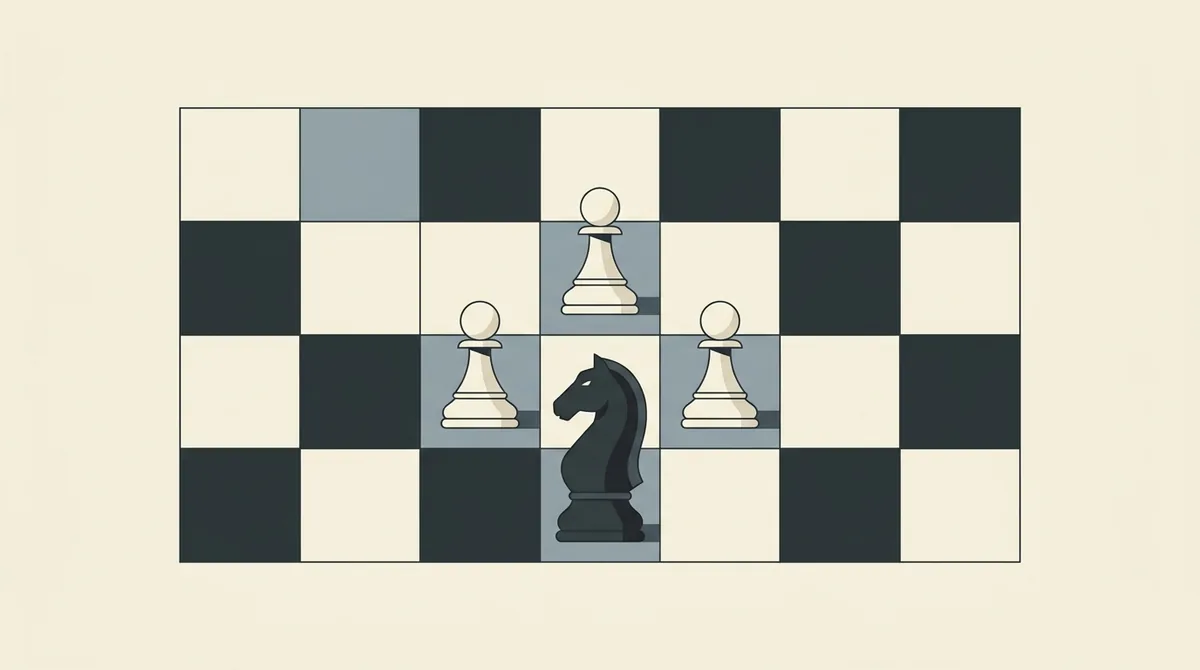
Quick answer
Quick answer: A backward pawn is one that has fallen behind the pawns beside it and cannot safely advance. It's a weakness, and a manageable one.
The pawn itself is rarely the problem. The empty square in front of it is.
That square becomes a home for an enemy knight, and the knight is what actually hurts you.
So the plan is always the same. Either push the pawn and end the problem, or control the square so nothing can sit on it.
The definition, precisely
Worth being exact, because people call any awkward pawn backward.
A backward pawn is behind all the pawns of its own colour on the adjacent files, and it cannot be safely advanced.
Both halves matter. A pawn that's simply behind its neighbours but can advance freely is not backward, it's just a move behind.
The definition is worth reading once, because the cannot advance clause is the whole diagnosis.
I checked the wording because club players use the term for any pawn that looks awkward, and half of those are perfectly healthy. If pushing it is possible next move, you don't have a weakness. You have a task.
Why it cannot be defended by a pawn
This is the structural fact underneath everything else.
A pawn is defended by a pawn diagonally behind it. A backward pawn is behind its neighbours, so there is nothing behind it to do the job.
That means every defence has to come from a piece.
And a piece tied to a pawn is a piece not doing anything else, which is the real cost.
Pieces devoted to protecting a backward pawn become weak themselves, because they can't leave. You end up with a rook whose entire job is standing still.
The hole is the real weakness
The square in front of the pawn, and it's worth more to your opponent than the pawn is.
Because no pawn of yours can ever attack that square, a piece placed there is permanent.
Usually a knight, sometimes a bishop or a rook, and once it lands it cannot be chased.
Worse, your own pawn blocks the file, so your rooks and queen behind it cannot attack the intruder either.
Your weakness defends their strong piece. That's the whole mechanism in one sentence, and it's why backward pawns feel so uncomfortable to play.
The half open file
The second attack, and it comes from a different direction.
A backward pawn often sits on a file where your opponent has no pawn of their own.
That file is half open for them, so a rook or queen slides down it and attacks the pawn directly.
Now you're defending against a knight in front and a rook behind, with pieces that can't move.
Two attackers against a pawn you can't push is how a small structural flaw turns into a lost position over twenty moves.
Losing it is worse than it looks
The knock on effect people miss when they count material.
If the backward pawn falls, the pawns beside it often become isolated, because it was the one connecting them.
So one pawn goes and two more weaknesses appear.
That's why a backward pawn is worth defending seriously rather than shrugging off as a single pawn.
Our isolated pawn post covers what you inherit when the connection goes.
How to fix it, first option
Push it, and this ends the problem completely.
The moment the pawn advances and is safe, it stops being backward, the hole in front of it is gone, and the file closes.
So the whole middlegame plan around a backward pawn is preparing that one push.
That usually means adding defenders to the square it wants to reach, or trading off the piece that's stopping it.
Everything else in this article is what to do while you're waiting for the push to work.
How to fix it, second option
Trade the piece sitting on the hole.
The knight in front of your pawn is the entire attack. Exchange it and the position is suddenly playable.
This is why a bishop that can reach that square is worth keeping, and why trading your good minor piece early is often the losing decision.
It's also why the side with the advantage avoids those trades and simply brings a second piece.
Our when to trade guide covers the general shape of this decision.
How to fix it, third option
Change the subject, which is the strongest practical answer.
A static weakness only matters if your opponent has time to attack it.
If you get counterplay somewhere else, they have to answer that instead, and your backward pawn sits quietly for the rest of the game.
This is what strong players do, and it's why they accept structural damage that a club player would panic about.
I compared several of my own losses with this pattern and the pawn was almost never the cause. Playing passively around it was.
When it is worth accepting
Deliberately, and there's a famous example.
In the Sveshnikov Sicilian, Black plays an early e5 that kicks White's knight and leaves a backward d pawn plus a weak square on d5.
The line describes it as giving Black dynamic potential, a central foothold and time gained on the knight.
It's been a first rate defence at the highest level for decades.
So the weakness is real, it's accepted knowingly, and the compensation is activity. That's the trade in a sentence.
Playing against one
The plan when your opponent has the backward pawn, and it's mechanical.
Put a knight on the square in front of it, and support it so it can never be traded off cheaply.
Double a rook and queen on the half open file to attack the pawn itself.
Stop the pawn ever advancing, since the push is their only real cure.
Then open a second front, because the defenders are already tied down and cannot cover two areas at once.
Do not fixate on it
The common mistake from the attacking side, and I've made it repeatedly.
Winning a backward pawn is not the goal. Restricting the position is.
Players spend fifteen moves manoeuvring to win a pawn, allow counterplay in the process, and end up worse with an extra pawn.
The pawn is a target that keeps your opponent passive. That passivity is what you're actually playing for.
Take it when it's free. Otherwise leave it there and improve somewhere else.
How to spot one early
Two questions during the opening, and they take a second each.
Which of my pawns can never be defended by another pawn?
And which square in front of my pawns can no pawn of mine ever attack?
If the answers point at the same file, you have a backward pawn coming and it's still cheap to avoid.
Our middlegame guide covers turning structural observations into an actual plan.
The endgame changes the verdict
A backward pawn is a middlegame problem far more than an endgame one.
With the queens and most pieces off, there's nothing left to sit on the hole, and a knight alone is much less frightening.
The pawn is still weak, and now your king can defend it, which costs you nothing.
So trading pieces is a genuine defensive plan when you're stuck with one.
That inverts the usual advice about avoiding trades when you're worse, and it's worth knowing.
Drill the structure, not the position
The useful way to study this, because positions never repeat and structures do.
Pick one opening you actually play and find where its backward pawn appears, since almost every opening has one somewhere.
Then learn the two plans that go with it, the push and the trade, rather than memorising moves.
That turns a vague worry into a known position you've handled before.
Our opening trainer drills your own lines, which is where these structures come from in your games.
The short version
A backward pawn is behind its neighbours and cannot safely advance, so no pawn can ever defend it.
The square in front of it is the real weakness, because an enemy knight there is permanent and your own pawn blocks your rooks from attacking it.
On a half open file you're defending from two directions at once with pieces that can't leave.
Fix it by pushing the pawn, trading the piece on the hole, or getting counterplay elsewhere.
And accept one knowingly when you get activity for it, which is exactly the Sveshnikov bargain.