Maia Chess: The Bot That Plays Like a Human
Maia chess explained: a bot trained on human Lichess games to play like a person, why it plays above its target rating, and what Maia-2 and Maia-3 changed.

Maia chess explained: a bot trained on human Lichess games to play like a person, why it plays above its target rating, and what Maia-2 and Maia-3 changed.

Sicilian vs Caro-Kann against 1.e4: how each defense plays, what White throws at it, how much theory you need, and which suits your style and rating.

How Lichess ratings work: why you start at 1500, what the question mark means, how time controls are split, and why the numbers look high next to FIDE.

Chess.com bots vs the Lichess computer: 100+ bot personalities against 8 Stockfish levels, what's free, what's unrated, and which suits your practice.
Lichess Patron unlocks no features. You get profile wings, and Lichess stays free, ad free and open source. What the money pays for, and how it compares.

The Scandinavian (1...d5) hits White's center on move one. The Caro-Kann (1...c6) prepares ...d5 for a solid game. Plans, risks, theory, and who each suits.

The Najdorf (5...a6) is the deepest studied Sicilian. The Dragon (5...g6) is sharper and simpler to set up. Plans, risks, theory load, and who each suits.
Chessbook builds your own repertoire and trains it with spaced repetition. Chessable sells 1,000+ authored courses. Prices, limits and who each suits in 2026.

ChessKid has no ads, no outside links and no social contact between kids and adults. Chess.com offers Safe Mode. Which fits your child, by age, in 2026.

A 1500 Chess.com blitz rating lines up with about 1600 USCF, with a 120 point margin. The conversion table, why it drifts, and how US Chess ratings work.

Stockfish still beats Torch, Chess.com's own engine. What each one is, where you can use them, which one Game Review runs, and which to pick in 2026.

Chessly gives one teacher and every course for one membership. Chessable sells 1,000+ courses one by one. How they differ in 2026 and which fits you.

What each Chess.com plan adds over the free account in 2026, what they cost, and which one is worth paying for depending on how you train.

Both start with 1.d4, but one is a system you can play against anything and the other is a fight for the center. Here is how to choose between them.

Both are solid answers to 1.e4 that fight for d5. The difference is one bishop. Here is how the Caro-Kann and French compare, line by line.

1.e4 leads to open, tactical games and 1.d4 to slower, closed ones. Here is how the two first moves differ, what you will face, and which fits you.
Your Chess.com rating and a FIDE rating measure different pools with different systems. Here is why they differ and how to judge where you stand.

AlphaZero beat Stockfish in 2017 and again in 2018, but the fine print matters. Here are the real scores, the criticism, and who is stronger now.

Both start 1.e4 e5 2.Nf3 Nc6, then split on move three. Here is how the Italian and the Ruy Lopez differ, and which one fits your rating and style.
Most players quit tactics training in week three. The fix is a smaller session, a rest day and a rule about when to stop, not more willpower.
Resigning too early costs club players real points. Here is when it makes sense, how to signal it, and the rule that scores a resignation as a draw.
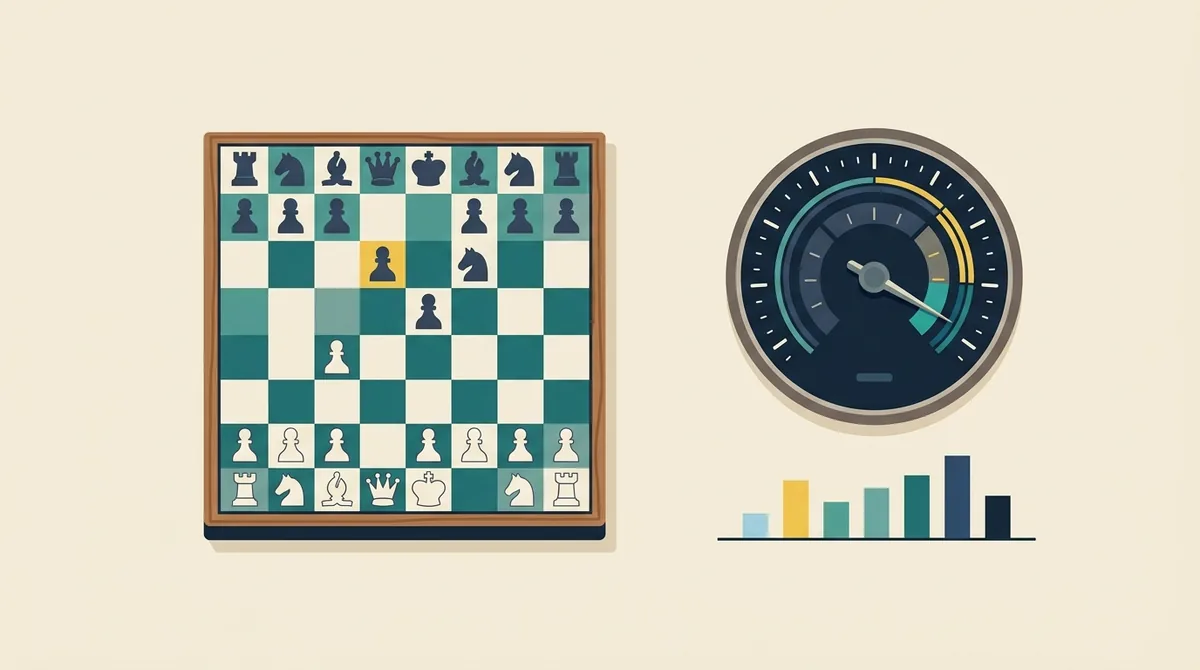
An accuracy score measures how much your winning chances fell, not how good your moves were. One site publishes the formula and the other does not.
Mate in one trains pattern recall. Mate in three trains search. They are different skills, and most players drill the wrong one for their level.
The fifty move rule is claimed, not automatic. The seventy five move rule is automatic. Here is what counts, what resets it, and why exceptions existed.
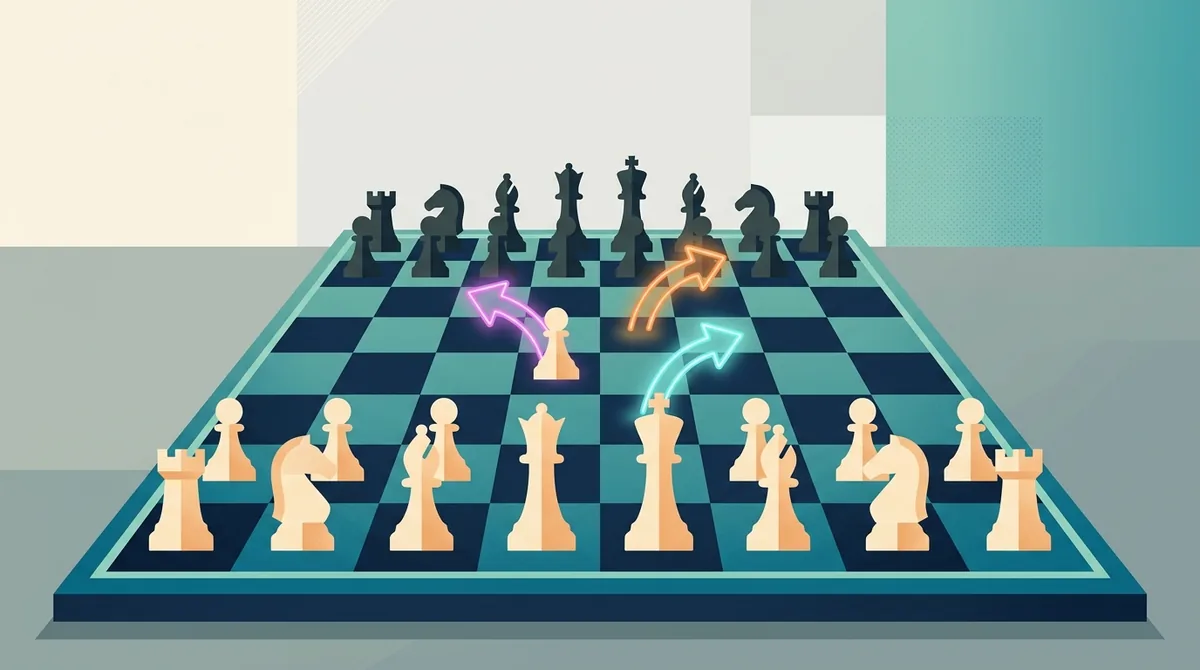
At 1300 the opening that wins is the one you can play from memory on a bad day. Here are three, with the reason each survives that level.
A flat rating for six months is not a talent ceiling. Here's what a plateau actually is, and the four changes that move it when nothing else does.
Two hundred points below your opponent is not hopeless. Here's what actually shifts the odds, and the three habits that hand stronger players the game for free.
A piece you are about to lose is not worthless. Here's how to make it take something on the way out, and the capture order that decides who profits.
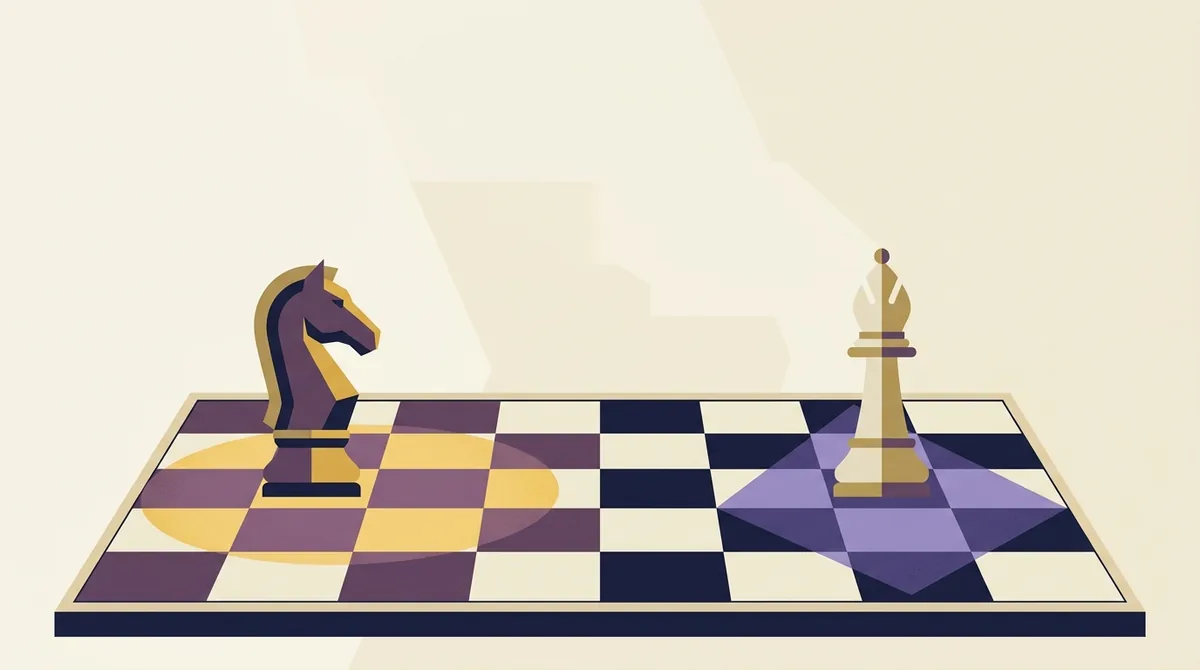
Both are worth three pawns and they are almost never worth the same. Here's how to read a position in ten seconds and know which minor piece you want.
A pawn down in a rook ending and still drawing. Here's the third rank defence, the moment you switch to checking, and the one move that throws it away.
A rook and a pawn on the seventh, and one technique that converts it. Here's the bridge, move by move, and the two cases where it doesn't work.

A pawn up and you still can't win. Two pawns up and often the same. Here's when opposite colored bishops draw, and the setups that actually win.

Don't start with all thirty two pieces. Start with four, let them win, and stop before they want to. Here's the order that keeps a child playing.

King and two bishops is a forced win in at most nineteen moves. Here's the method that works every time, and the stalemate that ruins it.

One punishes mistakes with time, the other ends your run after three. That single difference changes what each one trains. Here's which to pick.

A 1500 bot punishes loose pieces and never gets tired. It also has habits you can plan around. Here's the practical way through one.

Most players who feel cheated were not. Here's what real engine use looks like, what it doesn't, and the one thing worth doing instead of guessing.
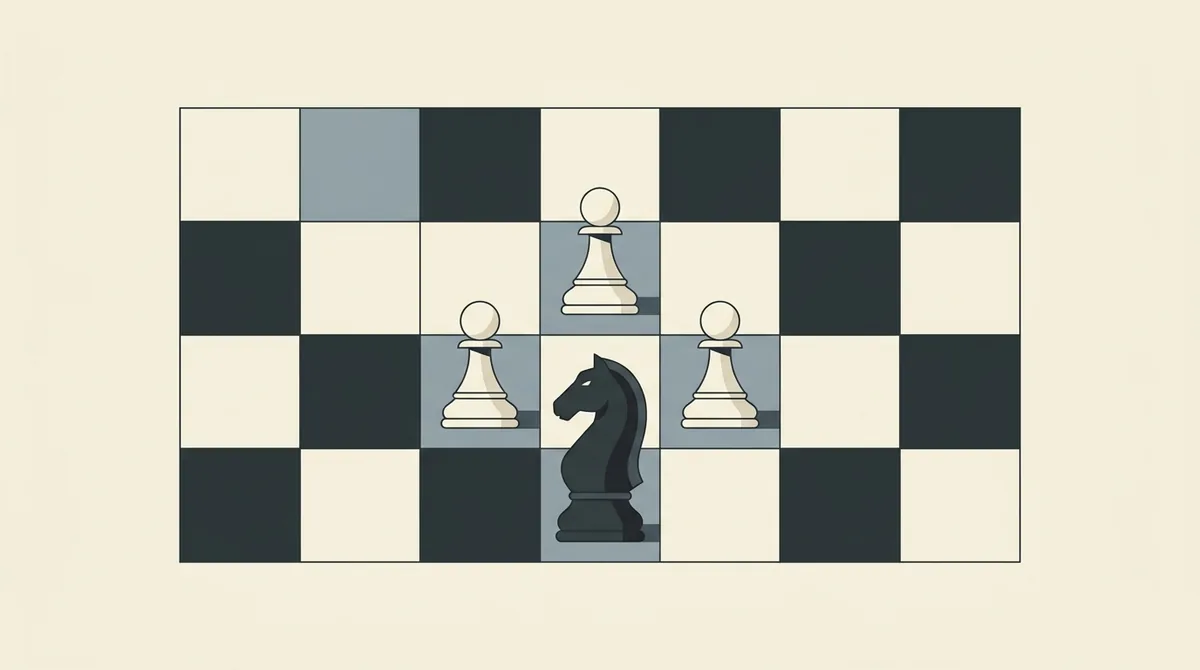
A backward pawn hands your opponent a square and ties a piece down. Here's when it loses the game and when it is worth accepting.

Stalemate, repetition, the fifty move rule, insufficient material and agreement. Here's how each one works and which you have to claim.

Turn up early, write down every move and leave your phone in the car. Here's what actually happens at an over the board event.

A queen is right almost every time, and twice a year it loses the game. Here's when a knight or a rook is the winning choice.

A grandmaster needs 2500 and three norms, and keeps the title for life. Here's every title, what a norm really is, and why the rating is the easy part.

Touch a piece and you must move it. Here's exactly what counts as touching, how j'adoube works, and when the rule does not apply.

Players from 800 to 1000 need fewer openings and more clean moves. This weekly chess plan balances slow games, tactics, review, and basic endings.

Chess engine scores are estimates, not verdicts. Learn what positive, negative, and changing evaluations mean, then write useful review notes.

A bot game is useful when the review captures your decisions. Learn to save the record, separate assistance, and build a transferable lesson.

A Lichess Study can hold your whole opening repertoire, but most become cluttered move dumps. Build chapters, notes, and recall drills that stay usable.

Compare Lichess and Chess.com analysis tools without chasing labels. Learn a practical review workflow that turns engine output into useful study.

Game Review labels every move, but the labels alone won't improve your chess. Use the graph, retry mode, and your own notes in the right order.
If you calculate three moves ahead and then lose track of the board, the problem is visualization. Here are the drills that fix it and the ones that waste time.

Being a piece up is not the hard part. Here is why winning positions slip away, and the five habits that turn an advantage into an actual point.
Beginners avoid doubled pawns on principle and lose games doing it. Here is when they are genuinely bad, when they help, and how to tell in one look.
Most club games are decided by one move nobody checked. Here is the short routine that catches it, and why players drop it exactly when it matters.
Endgame books start in the wrong place for club players. Here is the order that converts to rating points, and what you can safely skip for years.
Most club players study four times more opening theory than their games ever use. Here is the real number of lines, and the depth that matters.
Most players read the win percentage and pick the highest. That is the wrong column. Here is how to actually use an opening explorer to build a repertoire.
A Welsh sea captain's pawn sacrifice from 1827 that Kasparov revived. Here are the main lines of the Evans Gambit and whether it survives above 1800.
Sometimes being a rook down is a draw. Fortresses are positions material cannot break, and engines are famously bad at spotting them. Here is how to build one.
Interference drops a piece in front of a defender so it can no longer defend. Here is how it differs from deflection, plus the Novotny and Plachutta themes.

Give up a pawn on move three and get two open files and permanent queenside pressure. Here is the Benko Gambit, its main lines, and who it actually suits.

A rook and bishop working together can strip a whole position while the enemy king is powerless. Here is how the windmill works and how to set one up.

1...Nf6 invites White to chase the knight and overextend. Here are the Four Pawns Attack, the Modern Variation and the practical traps that win games below 2000.
2.Bg5 sidesteps the King's Indian, Grunfeld and Nimzo in one move. Here are the main replies, the structures you actually get and where the Trompowsky backfires.

A passed pawn decides more endgames than any tactic. Here is how to manufacture one from a majority, why the outside passer wins, and the right way to blockade.

Trading is not neutral. Here are the rules that decide a good exchange from a bad one, why trading when ahead works, and when swapping queens is the losing move.

An x-ray works through your own piece or the opponent's, which is why it hides so well. Here is how it differs from a skewer, plus the defensive version nobody teaches.

Carlsen won the first FIDE Freestyle world title in 2026 and club players keep asking what the format is. Here are the rules, the castling trap and whether it helps you.

Losing won positions on the clock? Here's how to manage your time in chess — where to spend it, where to save it, and the habits that keep you out of time trouble.

Not all bishops are equal. Learn the difference between a good and bad bishop, how your pawn structure decides it, and how to fix a bishop that's doing nothing.

The bishop and knight mate is the hardest basic checkmate in chess. Here's the method, the W-maneuver, and how to force mate in the right corner before the 50-move rule.

An overloaded piece is defending too much at once. Learn to spot overloading, the tactic behind countless combinations, and how to punish a piece with too many jobs.
The Petrov Defense is Black's rock-solid answer to 1.e4, famous for neutralizing aggression. Here's how to play it, the key traps to dodge, and why it's so hard to beat.

The isolated queen's pawn is chess's great debate — dynamic asset or endgame liability. Here's how to play with an IQP, and how to play against one.

Deflection forces a defending piece off its duty so you can strike. Here's how the tactic works, how it differs from a decoy, and how to spot it.
Chess notation looks like code until it clicks. Here's how algebraic notation works so you can read any game, book, or puzzle with confidence.

The opposition is the key to king and pawn endgames. Here's what it is, how to take it, and how it decides whether you win, draw, or lose.

Castling has more rules than people think. Here's how to castle kingside and queenside, and the exact conditions that stop you from castling.

Stalemate is a draw; checkmate wins. The difference is one question: is the king in check? Here's how to force mate and stop throwing away won games.

The Dutch Defense (1.d4 f5) is an aggressive answer to 1.d4. Learn the Leningrad, Stonewall, and Classical setups, the plans, and whether it fits your style.
En passant lets a pawn capture a pawn that just moved two squares, as if it moved one. Here's exactly when it's legal, why it exists, and how to use it.
Is Chessable worth it in 2026? I drilled a course for 30 days using its MoveTrainer spaced repetition. Here's what worked, what didn't, and who should buy it.
The July 2026 FIDE rating list is out. Magnus Carlsen dropped 18 points but stays the world's only 2800 player, while champion Gukesh slid to 2717.
A zwischenzug is a surprise in-between move played before the expected recapture. Learn how this intermezzo wins material, with a famous Morphy example.
The Grünfeld Defense lets Black hand White a big center, then tear it down with pieces. Learn the Exchange Variation main line, plans, and who should play it.

The Greek Gift sacrifice (Bxh7+) rips open a castled king. Learn the exact conditions that make the classical bishop sac sound — and when it just loses a piece.

Knight endgames play like pawn endgames with a twist — knights can't lose a tempo. Learn the rook-pawn fortress, winning with an extra pawn, and key draws.
Smothered mate traps a king with its own pieces so a lone knight delivers checkmate. Here's the Philidor's Legacy pattern, move by move, and how to spot it.

The back-rank mate ends countless games in one move. Here's how it works, how to create luft so it never happens to you, and how to land it yourself.

I used Aimchess to find my chess weaknesses. Here's an honest 2026 review of what it does well, where it falls short, and whether the Pro plan is worth it.
Try to hold the gambit pawn in the QGA and you can lose a piece to the old Qf3 trap. Here's how the trap works and the safe way to play Black.
Can you really improve by playing chess against bots? Here's what bot practice is great for, where it falls short, and how I use it to climb rating.
A discovered attack hits two targets at once by moving one piece to unveil another. Here's how to spot it, set it up, and not walk into one yourself.
Which openings does Beth Harmon actually play in The Queen's Gambit? A look at her real Sicilian Najdorf, Queen's Gambit, and the famous knight on f6.

The Pirc Defense (1.e4 d6 2.d4 Nf6 3.Nc3 g6) lets Black give White a big center, then strike back. Here's how to play it and survive the Austrian Attack.

The King's Gambit (1.e4 e5 2.f4) is chess's most aggressive classical opening. Here's how to play it, the accepted and declined lines, and the traps.

The Scotch Game (1.e4 e5 2.Nf3 Nc6 3.d4) opens the center early and avoids the Ruy Lopez maze. Here's how to play the main lines as White.

The Vienna Game (1.e4 e5 2.Nc3) is an underrated aggressive weapon for White. Here's how to play the main lines and the Vienna Gambit attack.

Stuck at 1200-1500 Elo? Here's the exact opening repertoire I built to break out — three openings as White and Black, tested over hundreds of games.

The Catalan is one of the most positional weapons against 1...d5 systems. Here's a complete guide to playing the Catalan as White in 2026 with main lines.

Aimchess Pro costs $14/month. Here's a tested list of free and cheaper AI chess coach alternatives that do most of what Aimchess does in 2026.

The Nimzo-Indian Defense is the most respected response to 1.d4 c4 at every level. Here's how to play it as Black, with main lines and a practical plan.

Praggnanandhaa won Norway Chess 2026 with 18 points after four straight classical wins. Here's how he beat Carlsen and Gukesh, and what this run means for him.
Stockfish is still #1, Leela has the most human-like style, Komodo is the strategic choice. Here's which chess engine to use for what in 2026.
Going from beginner to 1500 on Chess.com takes anywhere from 6 months to 5 years. Here's what determines your timeline and the fastest path I've seen.
I solved 500 chess puzzles across Chess.com, Lichess, ChessTempo, and CheckmateX in May 2026. Here's which platform actually trains your tactics best.
Lichess ratings are 200-300 points higher than Chess.com ratings below 2000. Here's the actual math behind the gap and what your real strength is.
I built a specific 30-day calculation routine and tracked the results. Here's what worked, what didn't, and how my accuracy score changed over the month.
Forget memorizing openings. Here are the 6 principles that actually govern moves 1–10 in chess — and why most beginners ignore the most important one.

The Slav Defense is one of Black's most solid answers to 1. d4. Here's how I learned to play it, what the key ideas are, and how to avoid the common traps.
I spent 6 weeks testing 7 free chess trainer apps back to back. Here's which one actually improved my opening accuracy — and which ones wasted my time.
The English Opening gives White a flexible, positional game without memorizing endless theory. Here's how I learned to play it and what makes it so dangerous.
Bishop endgames look simple but they're full of traps. Here's how to convert winning positions, create passed pawns, and handle opposite-color bishops.
I spent weeks testing Lichess and Chess.com specifically for opening study. Here's which platform actually builds opening prep that holds up in real games.
The Scandinavian Defense is aggressive, direct, and surprisingly solid. Here's how to play it as Black and what traps to watch for in 2026.
These opening traps have cost me hundreds of games — and won me just as many. Here are the ones every chess player should know, both sides of the board.
AI chess coaching exploded in 2026. I spent three months testing the best tools — here's what actually works, what's overhyped, and what to use.
The Caro-Kann is Black's most solid answer to 1. e4 — no theory overload, clean pawn structure, and real winning chances. Here's how to start playing it.
The Ruy Lopez is White's most respected weapon against 1...e5. Here's how it works, what Black's best responses are, and how to train it fast.

Searching for the best chess trainer to learn chess in 2026? I compared CheckmateX, Chess.com, Lichess, and Chessable so you don't have to.
Most players study chess openings and forget them in a week. CheckmateX's spaced repetition trainer changes that — here's exactly how it works.
The Italian Game is the most beginner-friendly chess opening. Here's how to play it correctly, what plans to follow, and why it works at every level.

The Fried Liver Attack is one of chess's most explosive sacrifices. Here's how to play it as White and how to survive it as Black.

Zugzwang is one of chess's most powerful ideas — when moving hurts you. Here's what it is, how to create it, and how to escape when you're caught in it.
AI chess coaching apps promise to replace human coaches. I tested the top options in 2026 — here's what actually works and what's just marketing hype.

The French Defense is one of chess's most fighting responses to 1. e4. Here's how to play it, handle the bad bishop problem, and win with Black.
The Caro-Kann is one of the most solid responses to 1. e4. Here's how to play it, what plans to follow, and why it might be your best opening as Black.
Stuck between 1200 and 1800 for months? Here's the structured improvement plan that actually works — no fluff, just the methods that produce rating gains.
Which chess platform actually helps you improve faster — CheckmateX, Chess.com, or Lichess? A brutally honest comparison of their training tools.
The King's Indian Defense is Black's sharpest answer to 1. d4. Here's how the opening works, what plans you need to know, and whether it fits your style.
Rook endgames are the most common and most misplayed endgames in chess. Here's a practical guide to the positions you'll actually face over the board.
Forks, pins, and skewers win more chess games than brilliant openings. Here's how each tactic works and how to start spotting them in your own games.

Queen's Gambit chess opening guide — how to play it as White, common Black defenses, key ideas, and traps to avoid.
Bullet, blitz, rapid, classical — each chess time control plays completely differently. Here's what each one means and which one actually makes you better.

The Sicilian Defense changed how I play as Black. Here's a practical breakdown of how it works and why it wins more games than passive alternatives.
Most players skip endgame study and pay for it constantly. Here's what you need to know about king and pawn endings — opposition, pawn promotion, zugzwang.
How to analyze your chess games effectively — the 5-step process I use to find mistakes, learn patterns, and stop blundering.
Your chess Elo rating predicts results against any opponent. Here's how it actually works, why Lichess and Chess.com numbers differ, and how to climb.
The London System gets hate from chess snobs, but it quietly wins games. Here’s why I switched, the key ideas you need, and how to train it fast.
I spent three weeks testing every major chess app. Here's my honest ranking — including one free app most players haven't tried.
You prep openings for hours, then lose by move 25 anyway. I spent six weeks fixing my middlegame and gained 200 rating points. Here's exactly how.
My blunder rate dropped 60% and my rating jumped 150 points in one month. Here's the exact daily routine and what surprised me most.
Stop losing in the first 10 moves. These 5 beginner openings (2 for white, 3 for black) are easy to learn and actually win games at every level.
I went from 2 blunders per game to less than 1 in 3 months. These 5 practical fixes actually work — no generic advice, just what changed my games.
Memorizing opening lines isn't working. Here's a practical training method that builds real opening knowledge you'll actually remember in your games.
One costs $100/year, the other is 100% free. After 8 years on both, here's my honest verdict on which is actually better for YOUR rating.
The trailer for Netflix's Carlsen-Niemann cheating scandal documentary just dropped. Here's what we know, what the trailer reveals, and why opinions are split.
The Chess.com Open 2026 kicked off March 14 with a $250K prize pool. Here's how qualifiers work, who's already in the playoffs, and how you can enter.
World Champion Gukesh has dropped to world No. 20 after losing game after game in 2026. Here's what's going wrong and whether he can bounce back.
Full 2026 Candidates Tournament guide — all 8 players, round-by-round schedule, pairings, and predictions for who challenges Gukesh in Cyprus.
Netflix's Queen of Chess tells Judit Polgar's story, but how much is accurate? Here's what the documentary nails and what it leaves out.