Quick answer
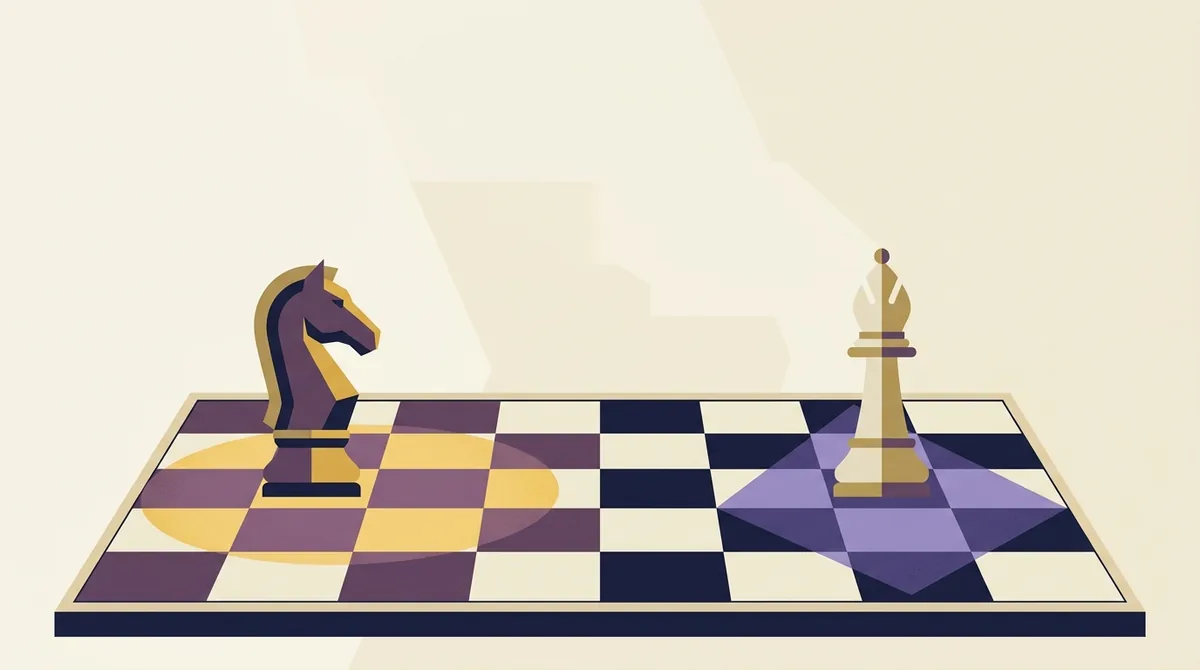
Quick answer: Open position with pawns on both wings, keep the bishop. Closed position with fixed pawn chains and a hole to sit in, keep the knight.
That one rule decides most of these trades correctly, and it takes ten seconds to apply.
I counted the pawns in the middle before deciding, in game after game, and that count predicts the right answer better than any other single signal. Four or more locked pawns and the knight wins the argument.
They are not both worth three
The three pawns figure is a beginner's shorthand and it hides everything interesting.
A bishop in an open position is worth noticeably more than three. A bishop stuck behind its own pawns is worth about two and a half.
A knight on a protected square in the middle of the board can be worth four. A knight on the edge is worth very little.
So the question is never which piece is better. It's which piece is better here.
What the bishop needs
Open diagonals and something to aim at.
A bishop is a long range piece that covers ground from a distance, so it wants the centre cleared and pawns that aren't sitting on its own colour.
It also wants targets on both sides of the board, because it can switch wings in one move and a knight cannot.
Give it those and it's the better piece. Take them away and it's a spectator.
What the knight needs
A square nobody can take it off.
A knight on a central square, protected by a pawn, where no enemy pawn can ever attack it, is one of the strongest pieces in chess. That square is called an outpost.
It also wants the position closed, because pawn chains block bishops and knights jump over them.
And it wants the action on one side of the board, since it's slow to travel.
An outpost on the sixth rank is worth more than one on the fifth, and one on the fourth is barely an outpost at all.
The colour complex test
Look at where your own pawns sit.
If most of them are on light squares and you have a light squared bishop, that bishop is blocked by its own army. Trade it.
If your pawns are on dark squares and you hold the light squared bishop, keep it. It covers everything your pawns don't.
That single check takes five seconds and it's the most reliable bishop test there is. We went through the whole idea in good bishop versus bad bishop.
The bishop pair is a separate thing
Two bishops together are worth more than the sum of two bishops, because between them they cover every square on the board.
So giving up one bishop to win a knight isn't a clean trade. You're also giving up the pair.
I compared how engines score the pair against how players talk about it, and both land near half a pawn in an open position.
Which means if you're holding both bishops, the bar for trading one is higher than the position alone suggests.
Pawns on both wings favours the bishop
This is the clearest signal and it decides endings.
With pawns on the kingside and the queenside, the bishop defends one wing and attacks the other without moving much. The knight has to walk, and walking takes four moves.
In an ending with three pawns each on opposite wings, the bishop is often winning where the knight only draws.
So when you're deciding a trade in the middlegame, look at where the pawns will be later, not only where they are.
All pawns on one wing favours the knight
The mirror of the same rule.
With everything on one side, the bishop's range is wasted. It can't use the empty half of the board and there's nothing to switch to.
The knight, meanwhile, reaches every square it needs within its slow radius, and it attacks squares of both colours.
That's why a knight and four pawns against a bishop and four pawns on the same wing is often better for the knight.
Locked pawn chains favour the knight
Count the pawns in the centre that can't move.
Four or more locked pawns and the position is closed enough that bishops struggle to find a diagonal worth having.
A knight in that position hops into the holes the chain leaves behind and can't be chased away.
This is the shape you get out of the French and the King's Indian, and it's why those openings produce good knights.
The chain has to be genuinely fixed. A centre that looks closed but can be opened with one pawn break belongs to the bishop.
Time matters too
A knight needs three or four moves to cross the board. A bishop needs one.
So in a sharp position where both sides are attacking, the bishop's speed is worth more than the knight's tricks.
In a slow manoeuvring position, the knight has time to get where it's going and the speed advantage disappears.
A useful question at the board is whether the position will still be like this in five moves. If yes, the knight has time.
The forks nobody sees
One practical reason knights win games above their theoretical value.
A knight attacks squares of the opposite colour to the one it stands on, which is a movement pattern humans read badly. Even strong players miss knight forks that they'd never miss with a rook.
So a knight is worth a little extra in a fast time control, purely because your opponent is more likely to blunder against it.
That's not theory. It's a practical edge and it's real.
The same blindness works against you, so check your own squares for forks before you trade into a knight ending.
Endings change the answer
Everything above applies more strongly once the queens come off.
In a middlegame the difference between the two pieces is often swallowed by the other pieces on the board. In an ending it decides the result.
So trade into the ending you want, not the one you happen to reach.
We covered both cases separately in bishop endings and knight endings.
A quick ten second checklist
Are there four or more locked pawns in the centre? Knight.
Are the pawns on both wings? Bishop.
Do I have a protected central square no pawn can attack? Knight.
Are my own pawns on my bishop's colour? Trade that bishop.
Do I hold both bishops in an open position? Keep them.
Those five questions settle nearly every minor piece trade you'll face.
If two answers point one way and one points the other, go with the majority and move on. This is a decision to make in seconds, not minutes.
When the answer is neither
Sometimes the trade isn't about the pieces at all.
Trading into a worse structure to win a slightly better piece is a common mistake. So is refusing a good trade because you prefer one piece in general.
The position decides. Your preferences don't.
The general rules about when to trade apply on top of all this, and we set them out in when to trade pieces.
How to actually practise this
Play the same opening from both sides for a month and watch which minor piece ends up better each time.
That's more useful than any list, because the pattern you build is specific to the structures you actually reach.
A bot with a fixed opening book is ideal for this, since it gives you the same shapes repeatedly.
Our play page lets you set that up in a minute.
The theory behind the numbers
Both pieces are classed as minor pieces and both are nominally three pawns, which is where the confusion starts.
Engines treat the values as positional rather than fixed, which is why an evaluation shifts when a pawn structure locks even though no material changed.
That shift is the whole subject of this page, expressed as a number.
If an engine suddenly likes your position less after a pawn move, look at your bishop.