Quick answer
Quick answer: Resign when you can see the whole path to your loss and your opponent has shown they can walk it. Below about 1600, that combination is rarer than people think, so most club players resign too early and give away points they would have won.
There's also a rule almost nobody knows. A resignation is sometimes scored as a draw.
I read the wording rather than relying on club folklore, because the etiquette around this gets repeated far more often than the rules do.
The rule you probably don't know
Under the FIDE laws, resigning normally loses you the game. There's one exception and it's a good one.
If your opponent has no way to checkmate you by any series of legal moves, your resignation is scored as a draw instead of a loss.
So if you resign against a lone king, or against a king and a single knight with no pawns, the result is half a point each.
That's rare, and it's the sort of thing that decides one tournament game a year somewhere.
How to actually resign
The signals matter more over the board than online, where there's a button.
I checked which gestures actually count, and two of the common ones don't.
Saying you resign is unambiguous and it's the right way to do it.
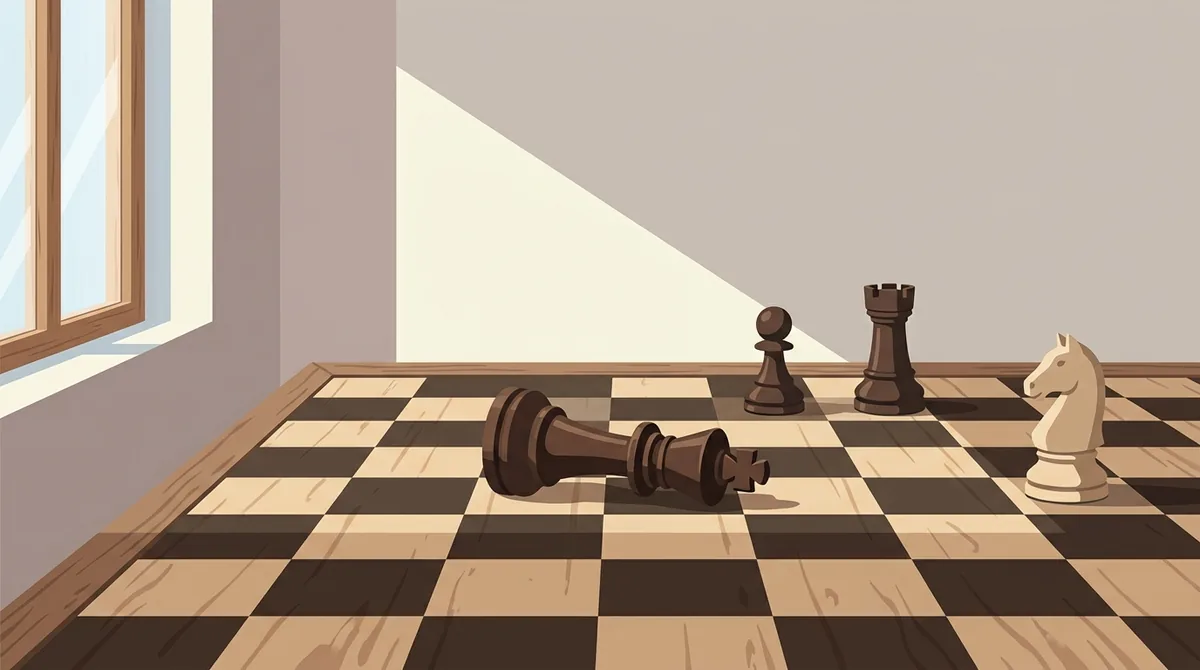
Tipping over your king also indicates resignation, though it has to be clearly deliberate rather than a knocked piece. That distinction has caused arguments.
Stopping the clocks is not a resignation, because clocks get stopped to call an arbiter. And offering a handshake is risky, since it can be read as a draw offer instead.
So the safest thing in a serious game is to say the word.
Why club players resign too early
The habit comes from watching strong players.
A grandmaster resigns a pawn down in a rook endgame because their opponent will convert it without trouble. That reasoning is sound at that level.
At 1200 it isn't. Your opponent has to find twenty accurate moves, and the odds they find all twenty are not high.
So copying the etiquette of a level you're not at costs you real points.
The two questions to ask
Before you resign, answer both of these honestly:
- Can I see the exact sequence that beats me, move by move?
- Has this opponent, in this game, demonstrated they can find it?
If either answer is no, play on. That's not stubbornness, it's arithmetic about your opponent.
What a lost position is really worth
A position that's theoretically lost is not the same as a game that's over.
Even completely winning positions get thrown away, and at club level they get thrown away often. Time trouble, a missed tactic, a stalemate trick, all of it happens.
So the value of playing on isn't zero. It's small, repeated across many games, and it adds up.
Put a number on it and the case becomes obvious. If one lost position in twenty turns around, that's half a point every twenty games, from doing nothing except staying at the board.
A player who never resigns early will finish the season with more points than an identical player who does.
When you genuinely should resign
There are real cases and they're worth naming.
A queen down with no compensation against an opponent who's been accurate all game. A completely lost endgame where the technique is simple and your opponent already showed it.
In a long classical game, playing on for another two hours in that position wastes your day as well as theirs.
That last part is the honest core of the etiquette argument. It's about time, not about pride.
The stalemate reason to play on
Here's a specific reason not to resign that beginners underrate.
Stalemate is a draw, and it happens most often when one side is overwhelmingly winning and stops paying attention.
If you're down to a bare king, your opponent has to avoid stalemate deliberately, and plenty of players below 1400 don't. A queen is the most dangerous piece to convert with for exactly this reason, because it covers so many squares that it takes them all away by accident.
You can help it along too. Walk your king towards a corner or an edge, where the trap is easiest to fall into.
So the very position that looks most hopeless is the one with a real saving resource in it. Our draw rules guide covers the five ways a game ends level.
Playing on is not disrespect
There's a persistent idea that playing a lost position insults your opponent. It's mostly imported from high level play.
At club level, finishing a game your opponent deserves to win is how they learn to convert. You're doing them a favour, not an insult.
Where it does become rude is playing on with no intention of resigning ever, in a dead drawn position, purely to run down a clock.
That's a different behaviour with a different name, and it isn't what we're describing.
Online is a different environment
The button makes resigning frictionless, and frictionless is the problem.
One click at the first sign of trouble becomes a habit, and the habit spreads to positions that were only slightly worse.
It also removes the small discomfort that used to make you check first. There's no moment where you have to say it out loud, and no opponent watching you decide.
The next game is one click away too, which makes quitting feel cheap rather than costly.
If you resign a lot online, go back through ten of those games and count how many you were actually lost in. The answer is usually surprising, and it's the fastest way to break the habit.
Bullet and blitz change the maths
In fast games, resigning is sometimes correct for a reason that has nothing to do with the position.
If you're clearly lost with thirty seconds left, playing on costs you the seconds and the next game is worth more.
But the opposite also holds. In bullet, a lost position with a time advantage is often a win on the clock.
So in fast chess, look at the clock before the board when deciding.
Against a stronger opponent
This is where the temptation is strongest and the decision is hardest.
A stronger player will usually convert, so the odds are genuinely worse. That's the honest part.
The other side is that you learn nothing from a game you didn't finish, and defending badly is a skill you can only build under pressure.
We went through the wider version of this in playing against a stronger opponent.
The resignation you'll regret
Almost every player has one. A position that looked lost, resigned in frustration, later found to be defensible or even winning.
That usually happens right after a blunder, when the emotion is highest and the judgement is worst.
So the practical rule is simple. Never resign on the move immediately after you blunder.
Take two minutes, look at the position as though someone else made the mistake, and then decide.
In a team match it is not only your decision
A point worth raising, because it catches people out at their first club season.
In a team or league match your result goes into somebody else's score. A resignation that feels reasonable to you might cost the team the match.
Captains often ask players not to resign until the other boards are settled, because a draw squeezed out of a bad position can decide the whole fixture.
So ask your captain what the policy is before the round rather than during it.
What to do now
Adopt one rule and stick to it. Don't resign unless you can name the sequence that beats you.
If you're over the board, say the words or tip the king deliberately. Don't stop the clock and don't offer a handshake, because both mean something else.
The exact wording sits in the rules of chess reference, including the case where a resignation scores as a draw.
Then go and finish a bad position on purpose. You can start a game on the play page.